Add up the watts of everything you will run at the same time, add the extra start-up power of the biggest motor (about three times its running watts), divide by 0.8 to get VA, then add about 20% headroom. A typical home with lights, TV, fridge and a 1 HP pump needs about 5 kVA.
Buying a generator that is too small means it trips or struggles whenever a fridge or pump starts. Buying one that is far too big wastes money and fuel. Here is how to get it right.
Step 1: List what you will run at the same time
Write down every appliance you want to run together during a blackout, with its power in watts. You will find the watts on the label or in the manual. Typical figures:
- LED bulb: 10 W
- TV: 100 W
- Fridge: 150 W
- Deep freezer: 250 W
- Laptop: 65 W
- Iron box: 1,000 W
- 1 HP water pump: 750 W
Step 2: Add up the running watts
Add the watts of everything on your list. This is the running load.
Step 3: Allow for motor start-up
Anything with a motor – fridges, freezers, pumps, compressors – needs about three times its running power for a second or two when it starts. Find the biggest motor on your list and add two times its running watts as extra. You only add this for the biggest motor, because motors rarely start at the exact same moment.
Step 4: Convert to kVA
Generators are rated in kVA. Divide your total watts by 0.8 (the usual power factor) and by 1,000:
kVA = total watts ÷ 0.8 ÷ 1,000
Step 5: Add headroom and round up
Add about 20% so the generator is not running flat out, then round up to the next standard size (2.5, 3.5, 5, 7.5, 10, 15, 20, 30 kVA and so on).
Worked example
10 LED bulbs (100 W) + TV (100 W) + fridge (150 W) + freezer (250 W) + 1 HP pump (750 W) = 1,350 W running. The biggest motor is the pump, so add 2 × 750 W = 1,500 W. Total 2,850 W ÷ 0.8 = 3.6 kVA. With 20% headroom that is about 4.3 kVA, so choose a 5 kVA generator.
Petrol or diesel?
- Petrol generators are lighter and cheaper to buy. They suit short blackouts, shops and portable use up to about 7.5 kVA.
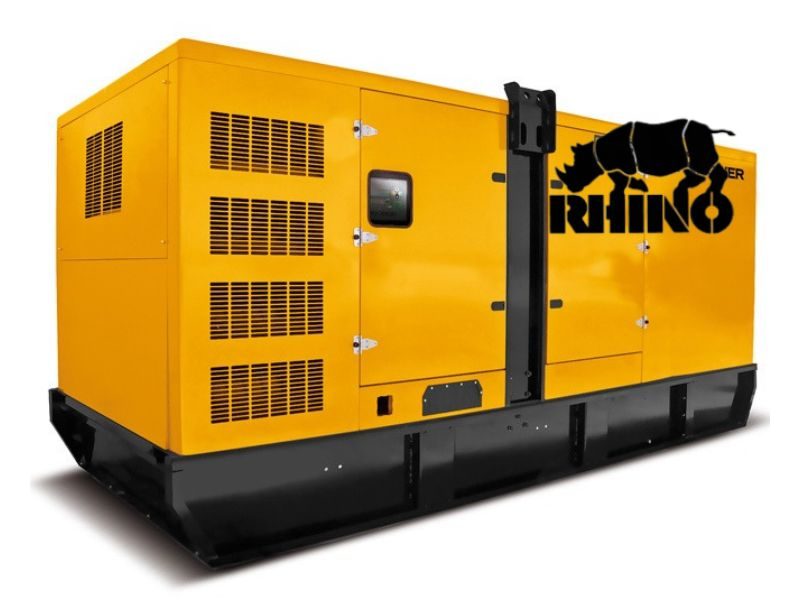
- Diesel generators use less fuel for the same power, last much longer and suit long daily running and bigger loads. Schools, hospitals, farms and businesses usually choose diesel.
Single phase or three phase?
Homes and small shops use single phase. Posho mills, workshops and buildings with large motors often need three phase – check your wiring before you buy.
Two safety rules
- Have a qualified electrician fit a changeover switch. Never plug a generator into a wall socket – it can push power back into the KPLC lines and kill someone working on them.
- Always run a generator outdoors, away from windows and doors. The exhaust contains carbon monoxide, which can kill without warning.
Want a quick answer? Use our generator sizing guide – tick your appliances and it works this out for you.
Common questions
What size generator do I need to run a house in Kenya?
A typical house with lights, TV, fridge, freezer and a small water pump needs about 5 kVA. A house with only lights, TV and phone charging can manage with 1 to 2.5 kVA.
Can a 2.5 kVA generator run a fridge?
Yes. A 2.5 kVA generator can run a fridge together with lights and a TV, as long as you do not add heavy loads like an iron box or electric kettle at the same time.
How long can a diesel generator run continuously?
Diesel generators are built for long running, but they still need stops for refuelling, oil checks and servicing at the hours given in the manual.
This guide gives general advice. For your exact machine, follow the manufacturer’s manual or ask our team.